 LE
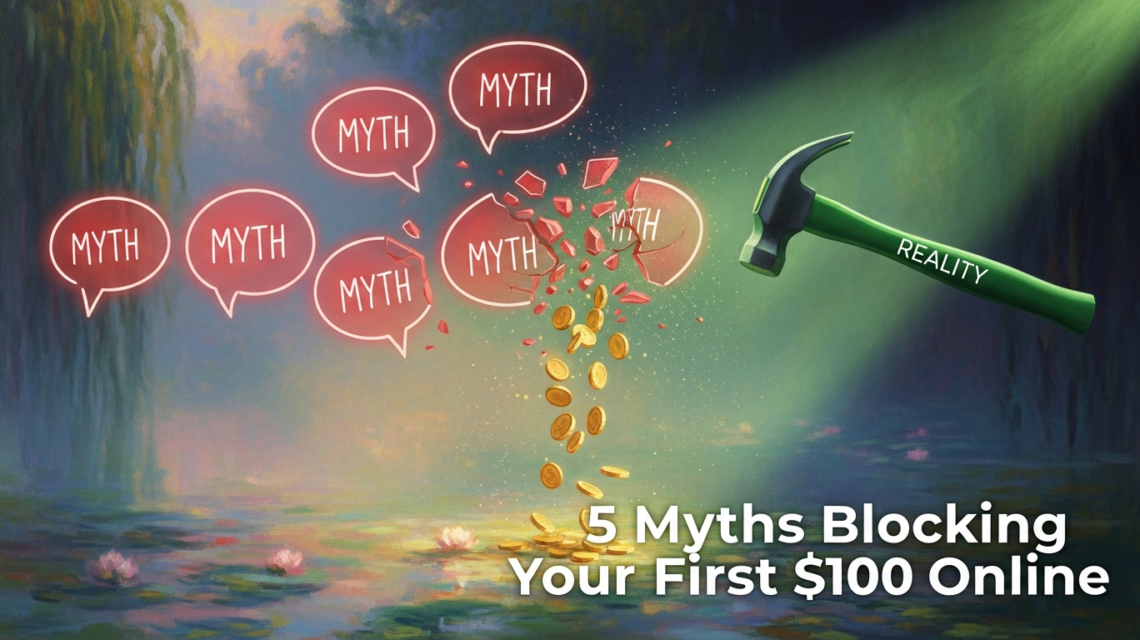
LE 5 Myths That Keep Most People From Earning Their First $100 Online (And the Reality)
The gap between “I want to make money online” and “I actually made my first $100” is surprisingly small on paper, yet huge in practice. Why? Because most beginners are held back by myths that sound logical at first glance but fall apart under real-world scrutiny.
Below are the five most persistent myths I see repeated in forums, Discord servers, Reddit threads, and private messages from people just starting out. For each one I’ll explain:
- what the myth claims
- why it feels true
- the actual reality in 2026
- what happens when you act on the reality instead of the myth
- one concrete action you can take today to break free of it
This isn’t motivational fluff. It’s pattern recognition from watching thousands of beginners — what separates the people who stay stuck at $0 from the ones who quietly cross $100, then $500, then $1,000+.
Myth 1: “You need a large audience before you can make any real money”
What people believe You must first grow to 5,000–10,000 followers on at least one platform before anyone will buy anything or click an affiliate link.
Why it feels true Big creators post screenshots of $5k–$20k months and they usually have tens or hundreds of thousands of followers. It looks causal: big audience = big money.
Reality in 2026 The first $100–$1,000 almost always comes from a very small but targeted group of people (often 50–300) who trust you enough to open their wallet. Many creators make their first few hundred dollars from:
- 20–50 email subscribers who got a free lead magnet
- A single Pinterest pin that drove 200–400 clicks to an affiliate link
- 10–30 DM conversations that ended in a $9–$37 product sale
- A Reddit comment thread where 5–10 people bought after seeing a helpful reply
Large audiences help with scale and stability, but they are not a prerequisite for the first dollars.
What happens when you believe the myth You spend months “building an audience” without ever asking for the sale → frustration → quitting.
What happens when you ignore the myth You focus on getting 50–100 people into your orbit who actually want what you offer → first sales appear much faster → confidence compounds.
One action today Decide on one tiny offer you can make available right now (even a $7 prompt pack or a $9 template). Put a clear way for people to get it in your next three posts (link in bio, DM trigger phrase, pinned comment).
Myth 2: “You have to spend money on ads or tools to make money”
What people believe Free organic traffic is dead or too slow in 2026. Real earners run Meta ads, Google ads, or at least pay for Canva Pro, Midjourney, or paid courses.
Why it feels true Paid ads scale fast when they work, and premium tools look more professional.
Reality in 2026 The first $100–$500 for the majority of beginners still comes from completely free channels:
- Pinterest organic pins (long lifespan, zero ad spend)
- Threads & X daily value posts + DM lead magnets
- Reddit value-first commenting in niche subs
- Free Facebook groups and Discord servers
- TikTok / YouTube Shorts (free to upload, algorithm still favors consistency over polish)
Paid tools and ads become useful accelerators after you already know what converts. Spending $50–$200 on ads before you have proof of concept is usually just burning money.
What happens when you believe the myth You either never start (can’t afford ads/tools) or start with a deficit (spend $200 before earning $1).
What happens when you ignore the myth You prove the model works with $0 spend → first profits fund better tools → you scale sustainably.
One action today Audit the last 10 things you paid for related to your online journey. Ask: “Did this directly cause my first dollar?” If not, pause it and redirect that energy to free posting on one platform.
Myth 3: “Your content needs to look professional / polished to sell”
What people believe Low-production-value posts, simple PDFs, basic Notion templates, or phone-recorded Loom videos won’t convert — people want Hollywood-level polish.
Why it feels true Top creators have beautiful thumbnails, edited videos, sleek branding.
Reality in 2026 First sales almost always come from “good enough + useful” rather than “perfect + pretty.” Buyers care far more about:
- Does this solve my exact pain right now?
- Is the person sharing it credible / relatable?
- Can I get the result quickly?
A plain 8-page Google Doc PDF titled “50 Prompts That Saved Me 10 Hours This Week” sold hundreds of copies for many creators in 2026. A 5-minute unedited Loom video explaining a Notion setup closed $97 coaching calls. Polish helps later — usefulness closes first sales.
What happens when you believe the myth You spend weeks designing → post nothing → no feedback → no improvement.
What happens when you ignore the myth You ship fast → get real buyer feedback → improve the thing people actually pay for.
One action today Create the ugliest possible version of your lead magnet or first product today (Google Docs bullet list is fine). Share it with 5–10 people (DMs, comments, group) and ask for honest feedback.
Myth 4: “You must be an expert / have credentials to sell anything”
What people believe You need years of experience, certifications, a big personal brand, or “proof” before anyone will pay you.
Why it feels true Gurus position themselves as authorities with long resumes.
Reality in 2026 You only need to be one step ahead of your buyer. The person who figured out a problem last month can sell the solution to someone still stuck there today.
Examples that sell every day:
- Someone who made $200 on Etsy last month sells “Etsy title prompts” to people at $0
- A freelancer who landed 3 clients sells a “client outreach template pack”
- A beginner who built one Notion dashboard sells the duplicate link for $17
Credentials help with high-ticket offers later. Early sales come from solving a specific, painful problem — not from a resume.
What happens when you believe the myth You wait years to “become qualified” → never start.
What happens when you ignore the myth You package what you already know → first buyers appear → you learn faster by teaching.
One action today Write down one small problem you solved in the last 3–6 months. Turn it into a one-page free PDF titled “How I [solved problem] in [timeframe]” and give it away today.
Myth 5: “You should wait until everything feels right before you start”
What people believe You need the perfect niche, perfect lead magnet, perfect branding, perfect posting schedule, perfect mindset — then you can begin.
Why it feels true Starting feels scary when nothing is certain.
Reality in 2026 The fastest path to clarity is messy action. Waiting for “ready” usually means waiting forever. The first $100 teaches more about niches, funnels, copy, and yourself than 200 hours of planning or courses.
Most people who hit $500–$2,000/month started with something “wrong” (wrong niche, ugly product, inconsistent posting) and iterated their way to right.
What happens when you believe the myth You stay in the research / planning phase indefinitely.
What happens when you ignore the myth You ship something imperfect → get real data → adjust → improve → earn.
One action today Set a hard deadline: “By [date 7 days from today], I will have published my first piece of content and offered something free or for sale.” Write it down. Tell one person (accountability helps).
Bottom line
These myths feel safe because they delay the scary part: actually putting something into the world and asking for money. The moment you treat them as myths instead of truths, the first dollars usually appear faster than you expect.
Pick one myth above that’s been holding you back. Decide today to act against it — even in a small way.
Progress beats perfection every time.
